SAP · S/4HANA Cloud & Business AI
Situation Handling
ROLE
UX Design Specialist
YEAR
2022 – 2024
COMPANY
SAP
Scope
Redesign · mobile · target vision · guidelines
The situation page: the issue, why it happened, and what to do about it, on one screen. Replace with your real screen or a short demo.
6 domains
Finance, supply chain, manufacturing, procurement, operations, sales
4 entry points
Home, notifications, list reports, object pages
4 levels
Of progressive disclosure
Platform-wide
Guidelines adopted across SAP
At a glance
UX Design Specialist · senior scope
Role
2022 – 2024
Timeline
Intelligent-systems expert, PO, research
Team
Redesign, mobile, target vision, guidelines
Platform
What I did
Redesigned the end-to-end experience for clarity across six business domains.
Built a four-level progressive-disclosure model across four entry points.
Created the mobile experience and authored the platform-wide integration guidelines.
Forward-looking AI target design reviewed by a senior SAP exec, influenced funding
overview
A case study about clarity.
This is a case study about making a sprawling, cross-domain system feel like one calm place to solve a problem.
Situation Handling is SAP's capability for detecting business exceptions, a late shipment, a missing payment, a stock shortfall, notifying the right person, and guiding them to resolution. The exceptions come from six different business domains, appear in many places, and each one needs a different fix. The design challenge was clarity at that scale.
I joined in 2022 and worked across the whole arc: redesigning the existing experience for clarity, building a progressive-disclosure model, creating the mobile experience, authoring the guidelines other SAP teams build on, and designing the forward-looking target state for the platform's move into machine learning and Generative AI. That future vision was reviewed by a senior executive and influenced
context
From detection to intelligence.
Organisations deal with unpredictable issues every day, in supply chain, finance, procurement, sales, and manufacturing. Most stay invisible until they block an order, delay an invoice, halt production, or upset a customer. Situation Handling exists to catch them early, across SAP S/4HANA Cloud, and guide users to a resolution before they become costly.
It works across past data, present activity, and future prediction. Early versions ran on rules; later phases brought in machine learning, and eventually Generative AI. As the intelligence grew, the experience had to evolve with it, so users could understand the situation, trust the guidance, and act efficiently, no matter how the answer was produced. Because the capability runs independently of the business applications, it also had to integrate cleanly and consistently across the entire SAP ecosystem.
The problem
Complexity in every direction.
The difficulty was not one screen. It was the spread. A situation could originate in any of six domains, each with its own logic and language. It could surface in several different places in the product. And the right resolution was never fixed, sometimes a quick approval, sometimes a multi-step investigation.
Exceptions arise across six business domains, each with distinct logic.
Issues stay invisible until they have already done damage.
They appear from many entry points and must feel consistent everywhere.
Solutions are dynamic, every situation needs a different resolution.
Users range from daily experts to occasional responders, on desktop and the shop floor.
My job was to take all of that and make it feel like one coherent, understandable system.
my role
System understanding, made visible.
My title was UX Design Specialist, but the cross-system impact and strategic nature of the work put it at senior-level complexity. I owned the experience across multiple releases: understanding the technical landscape and exception logic, partnering closely with the intelligent-systems expert and product owner, working with researchers, redesigning the current experience, designing the future one, creating the mobile adaptation, and writing the integration guidelines for other teams.
The engine of progress was whiteboarding. Long, collaborative sessions mapping cross-domain logic, finding the gaps in flows and exception handling, and building a shared mental model across teams. Much of the clarity in the final product came from first making the system legible to everyone designing and building it.
The core of the work
Designing complexity into one calm system.
This is the clearest example of the work I do most: taking genuinely complex enterprise software and making it simple to use, without removing the depth that experts depend on. Here is the complexity, and how I reduced it.
The complexity I was designing for
Six domains. Finance, supply chain, manufacturing, procurement, operations, and sales, each with its own logic.
Invisible until costly. Issues that go unnoticed until they block an order or delay an invoice.
Many entry points. The same situation could appear in home, notifications, list reports, and object pages.
Dynamic solutions. Every situation needs a different kind of resolution.
Two kinds of user. Daily experts and occasional responders, on desktop and the shop floor.
A moving target. Rules today, machine learning and Generative AI tomorrow.
How I made it one system
One situation page. What happened, why, and what to do, on a single screen.
Four-level progressive disclosure. The right amount of detail at the right moment, never more.
Consistent across entry points. One model wherever a situation shows up.
Flexible but coherent solutions. Different resolutions that still feel like one system.
Desktop and mobile parity. The same clarity in the office and on the floor.
Platform-wide guidelines. So every SAP team builds it the same way.
I made a system that spanned six domains feel like one calm place to understand and resolve a problem.
Design challenge 01
Understanding the issue at a glance.
The trust question: do I understand what happened, why, and what to do, immediately?
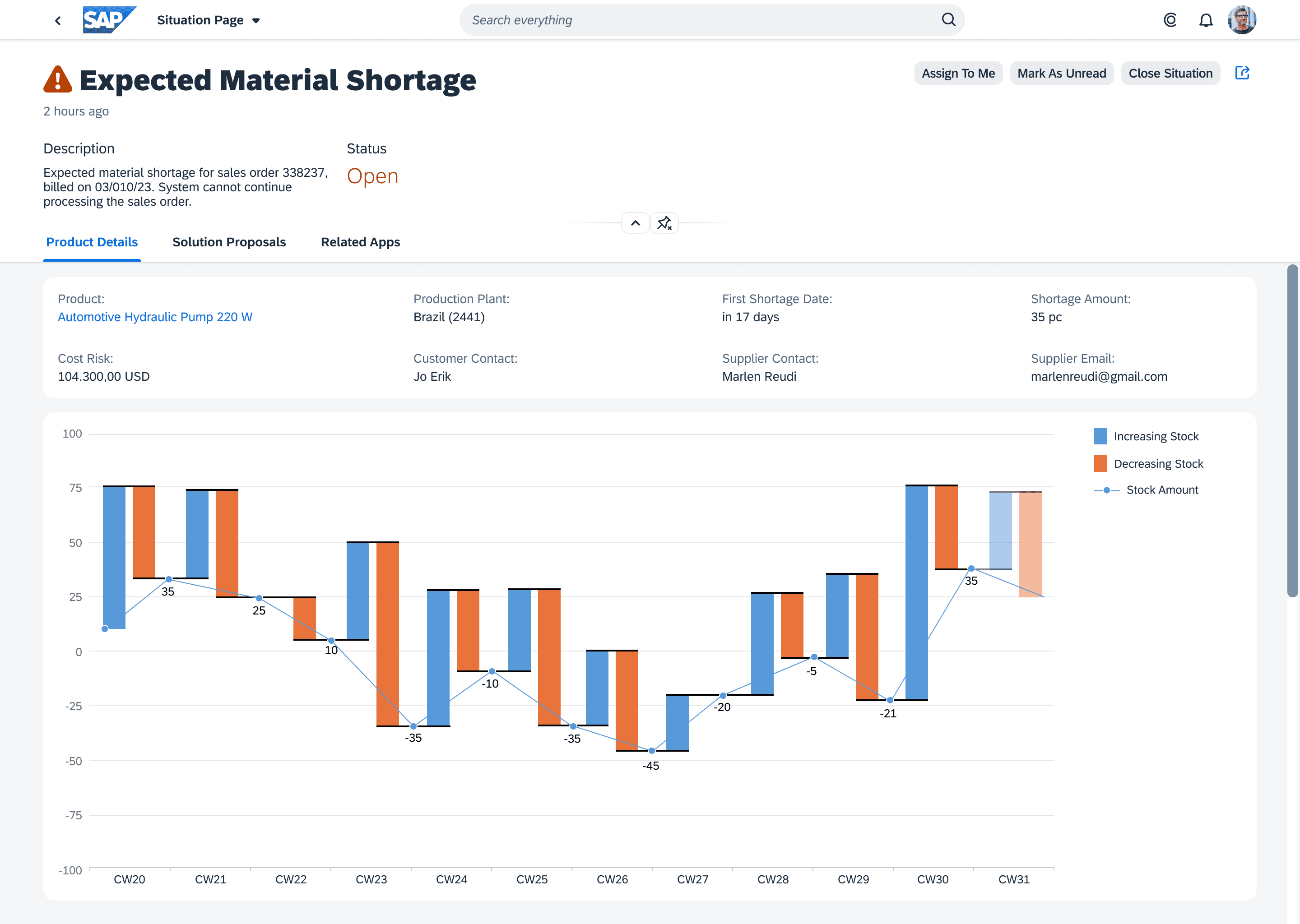
When a user opens a situation, clarity is everything. They need to grasp the issue, why it occurred, and what they can do next, fast. I structured the page around that: a clear header with the title, status, and primary actions; tabs for details, solution proposals, and related apps; a plain explanation with supporting visuals; solution cards; and easy navigation to the related business screens when needed. The hard part was balancing clarity, flexibility, and the depth that enterprise workflows demand, for both novice and expert users.
Design challenge 02
The right information at the right moment.
The trust question: am I told just enough, when it matters, without being interrupted?
A situation can appear from several touchpoints, on My Home as a to-do, in the notification panel, in list reports as an indicator, in object pages as a warning. Each had to feel intuitive and consistent. So I designed a four-level progressive-disclosure model, giving people exactly as much as they needed at each step.
Level 1, indicator. A small icon that signals a situation exists, without interrupting the work.
Level 2, compact card. Title, time, and a brief description, ideal for Home and the notification panel.
Level 3, popover. A hover reveals context and simple actions, without leaving the screen.
Level 4, full page. The complete context, solution proposals, and related apps, where the issue is resolved.
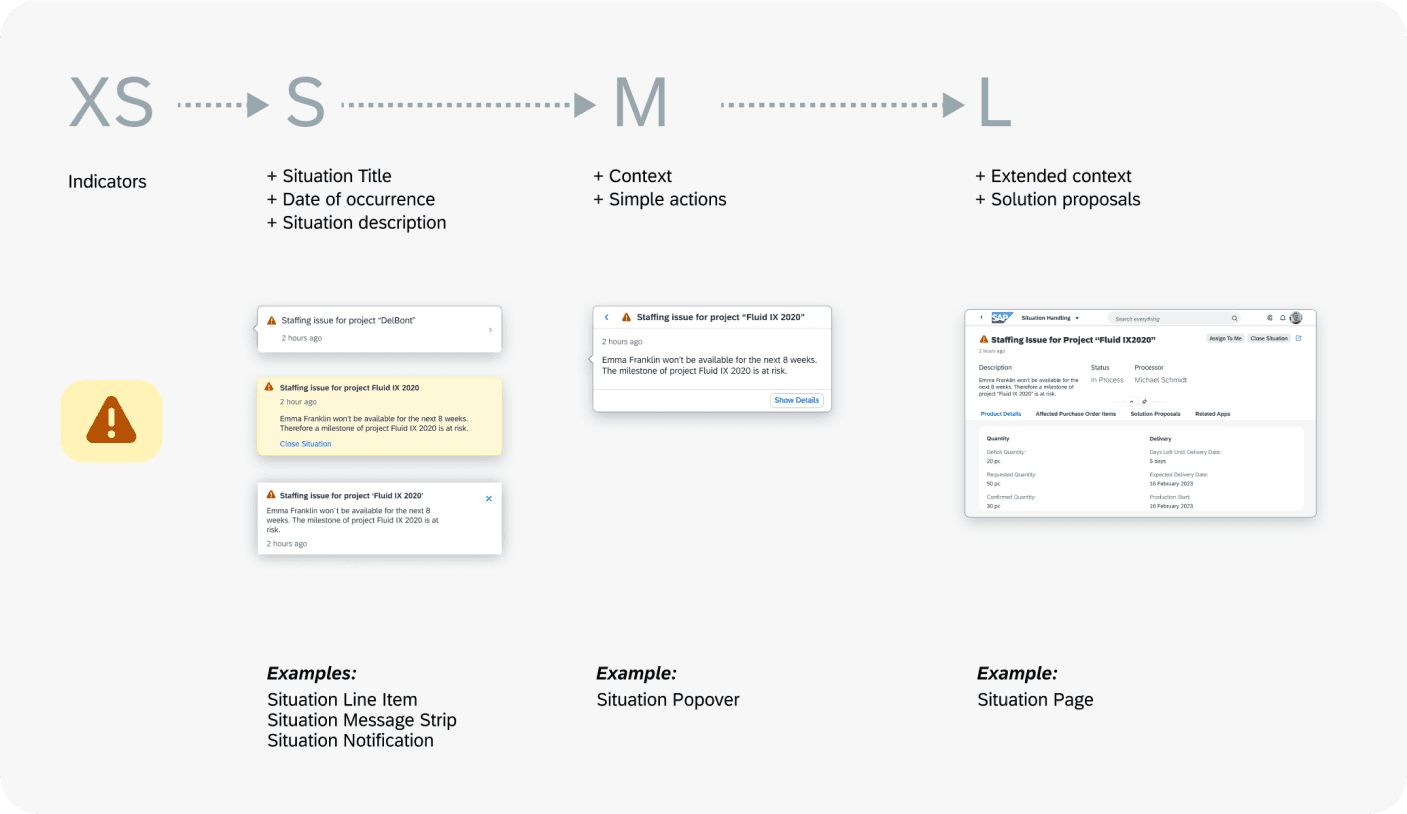
One model, four levels: a quiet signal, a compact card, a popover, and the full page, so people get exactly what they need at each step.
Design challenge 03
Many situations, one coherent way to resolve them.
The trust question: can I act on the recommendation with confidence, whatever the situation?
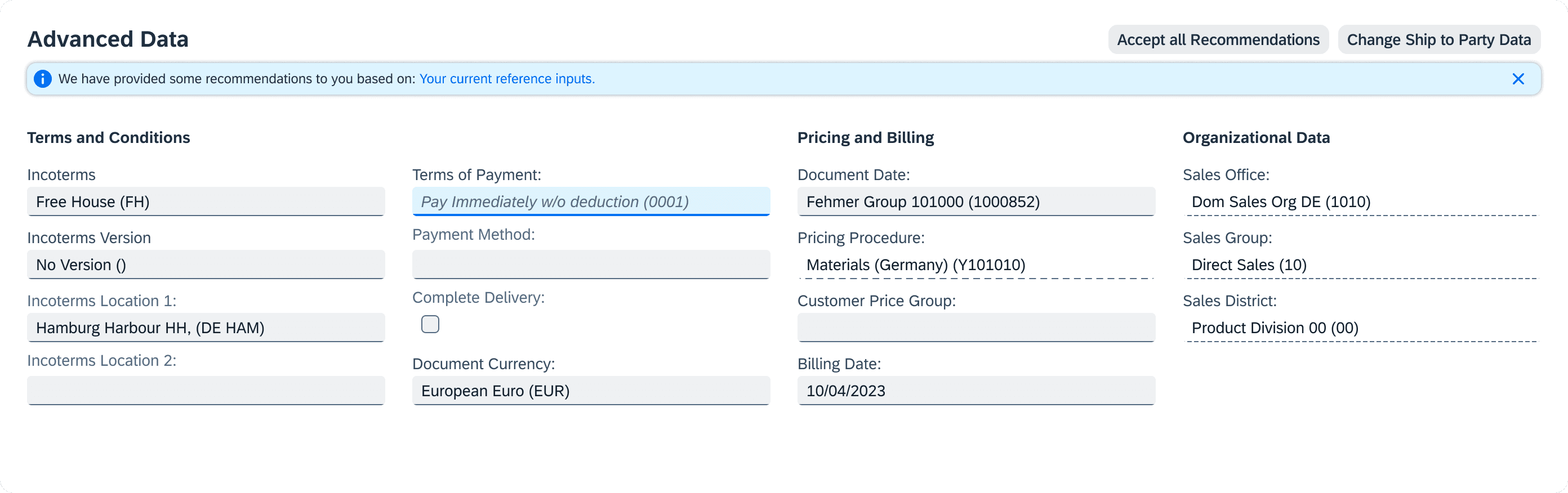
Solution proposals are never static. They depend entirely on the situation, adjusting an order, verifying missing information, reallocating resources, or composing a customer message. I designed flexible patterns for each category: a focused dialog with only the relevant fields for an order change; a one-action confirmation for a system-recommended payment fix; a clear explanation and approval for a replacement; and contextually surfaced related apps for anything needing deeper investigation. The challenge was making all of that variety feel coherent and predictable, part of one system, even though the underlying logic differs wildly.
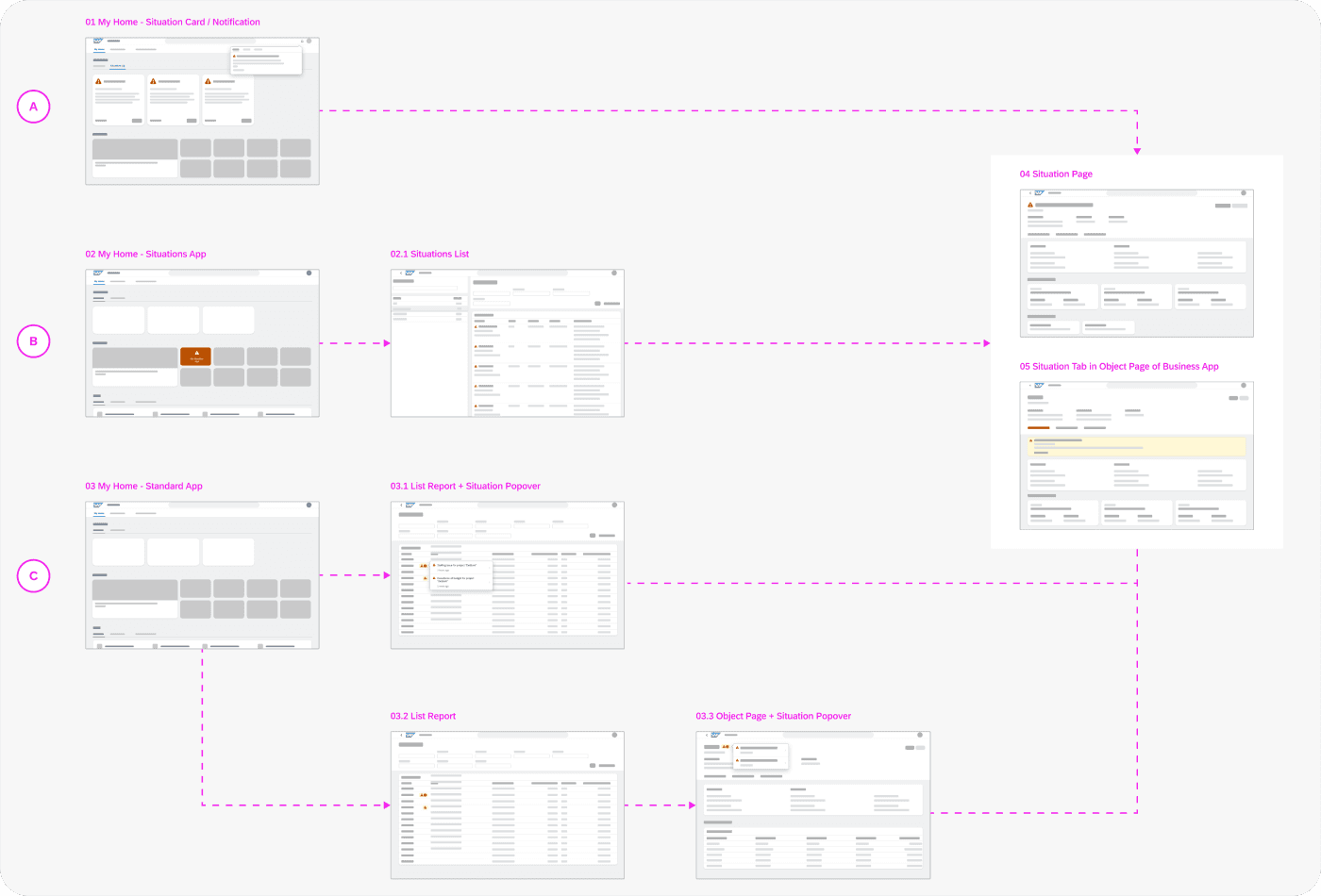
Three very different resolutions, one consistent grammar, so every situation feels like the same trustworthy system.
Telling the story
Three storylines, rising intelligence.
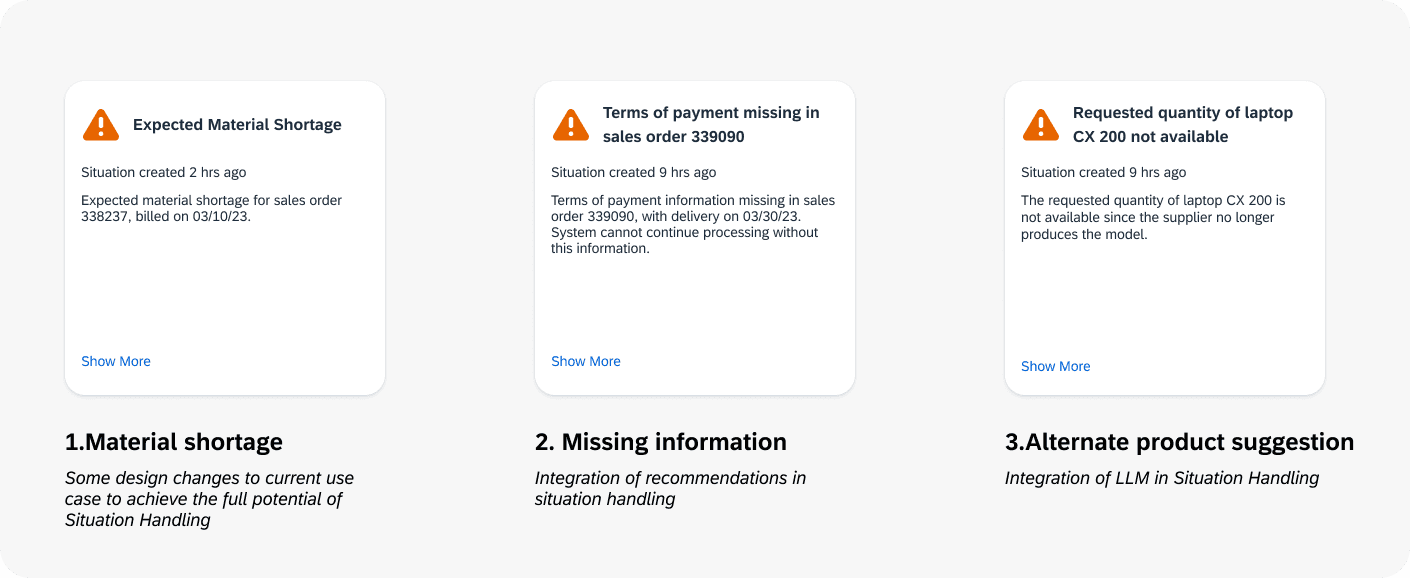
To make the value obvious, I built a three-part narrative that shows the system getting smarter, later used in the official product story. It walks from simple detection to AI-assisted resolution.
Material shortage. The system sees a required material will not arrive in time, warns the right person early, and recommends an action. A delay is prevented.
Missing payment. It spots an unreceived payment, frames the risk, and recommends a follow-up the user can approve or adjust.
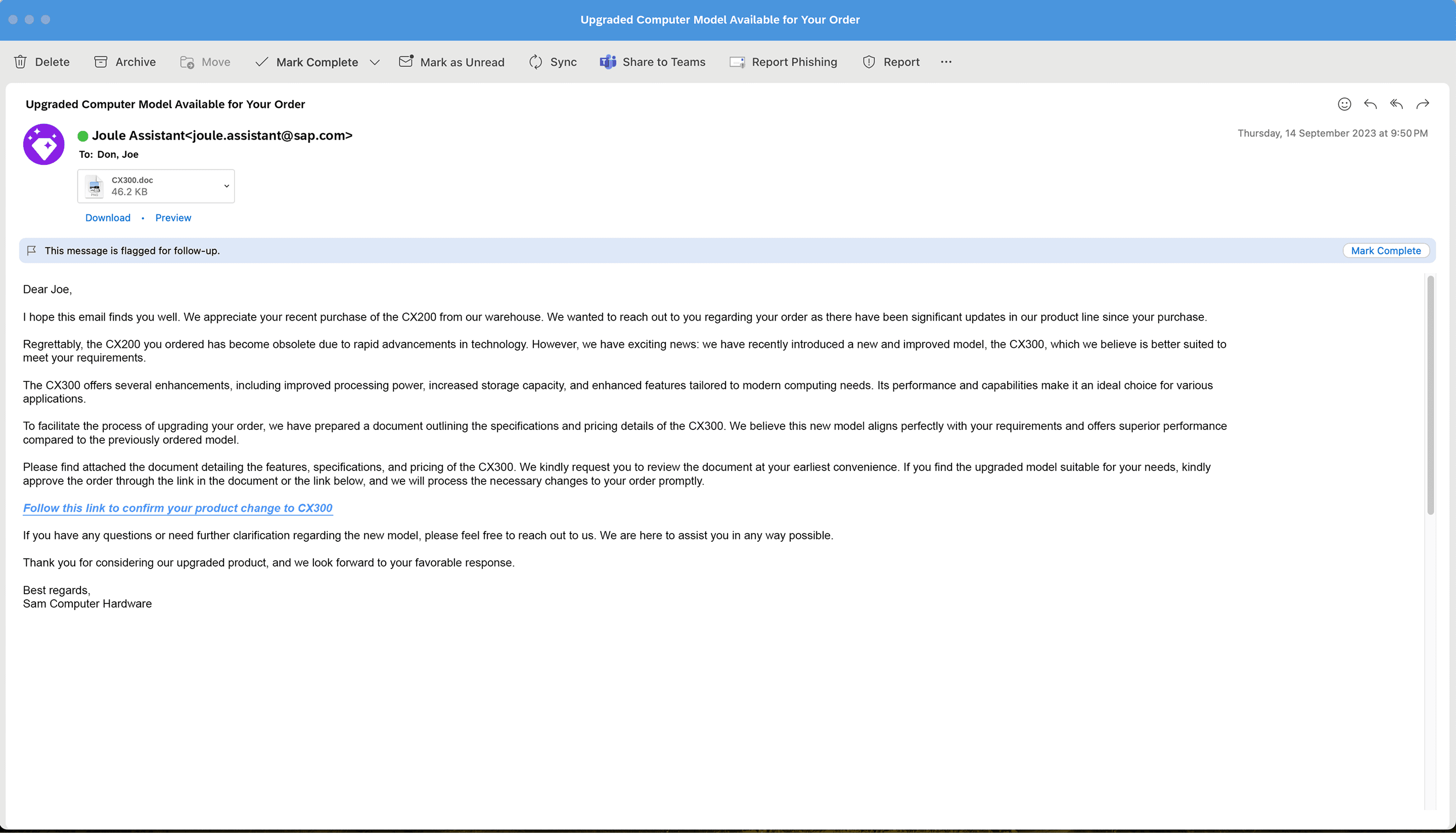
Device replacement. A customer wants an end-of-life product; the system finds the closest match, drafts the explanation, and on approval updates the quotation automatically, detection, guidance, and execution in one.
The future state
Designing the current product and its future at once.
Alongside the redesign, I designed the forward-looking target state: how Situation Handling could evolve into a predictive, proactive experience as machine learning and Generative AI matured. Those concepts were reviewed by a senior executive and influenced the roadmap. When SAP later moved decisively toward Generative AI, that target design became relevant again, and was validated, funded, and implemented in subsequent phases. Designing for both the present and the future, in one coherent system, is what kept the product from being redesigned every time the intelligence changed.
Impact
A foundation the whole platform builds on.
The work strengthened SAP's foundation for intelligent exception handling. It improved clarity and usability across every level of interaction, reduced cognitive load for people managing complex scenarios, and created a scalable pattern that other SAP business applications could adopt. The platform-wide guidelines I authored meant teams across the ecosystem could integrate Situation Handling consistently, on desktop and mobile alike. And by designing the AI-ready target state early, the work laid the conceptual groundwork for the platform's shift toward predictive, autonomous processes.
Reflection
This project was a mix of system understanding, UX clarity, and strategic thinking in equal measure. Redesigning the present, shaping an AI-enabled future, and aligning teams across six domains taught me how much of complex-software design happens before the first screen: in making the system legible to everyone who touches it.
What it taught me
Principles for complex enterprise UX.
The lessons from this project shape how I approach any large, multi-domain system.
Clarity is the feature.
In enterprise software, the win is rarely a new capability. It is making the existing one understandable.
Show the right detail at the right moment.
Progressive disclosure is how a complex system stays calm. Reveal depth only as it is needed.
One system, many situations.
Variety should still feel coherent. A shared grammar makes difference feel predictable.
Design the present and the future together.
When the intelligence will keep changing, design a frame that can absorb it without a redesign.
next